
Pagina Interattiva per sito (con AI)
Inserisci qui il tuo testo...
The Picture of Dorian Gray
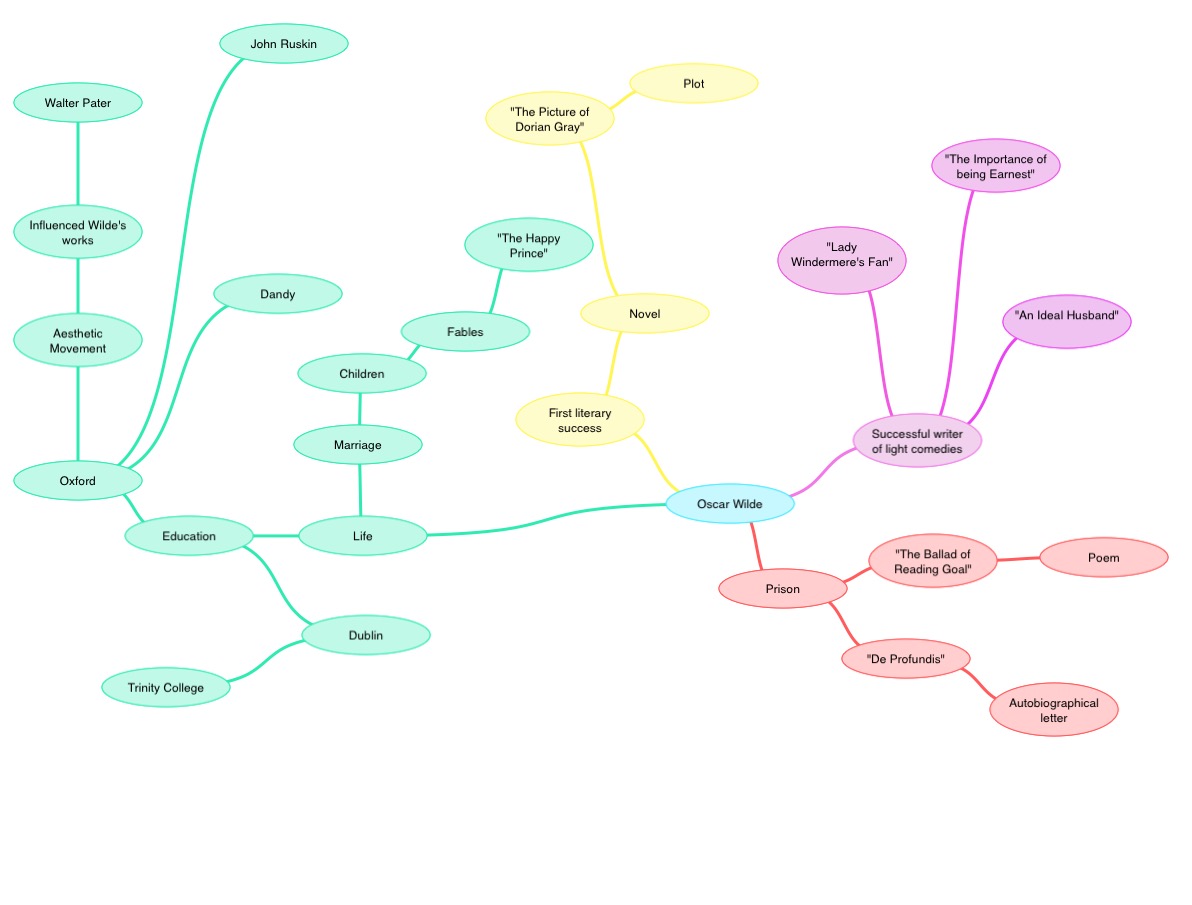
Oscar Wilde Biography Map goes here
Right-click your map image on the Oscar Wilde page in Webnode → Copy image address → paste into src=""This page is your complete study resource for The Picture of Dorian Gray. Click the Victorian Age or Oscar Wilde badges at the top to access context videos and the biography map. Use the tabs below to navigate the full literary analysis, mind maps, word lists, vocabulary flashcards and the interactive plot timeline.
Click on each literary element to expand the full analysis. Use these sections to prepare your oral presentation or written essay.
A variety of sources contributed to the composition of the novel. Two of the most significant are:
Ovid's Metamorphoses , Narcissus. The idea of vanity and obsession with beauty, explored throughout the novel, may be traced to Ovid's myth of Narcissus , a beautiful youth who falls in love with his own reflection and is ultimately transformed into a flower. Dorian's obsession with his own portrait and his refusal to accept ageing mirrors this myth directly.
The Legend of Faust. The idea of remaining young and wealthy in exchange for one's soul comes from the classic German legend of Faust , a scholar who sells his soul to the devil in exchange for worldly pleasures and knowledge. Dorian's wish that the portrait would age in his place is a direct echo of this Faustian bargain.
The title, The Picture of Dorian Gray, can be divided into two sections.
"The Picture" refers to the portrait painted by Basil Hallward. It captures Dorian's youthful charm and physical beauty perfectly. This part of the title hints at the concept of appearance.
"Dorian Gray" is the name of the novel's protagonist. This part of the title highlights the concept of reality , the inner truth that the portrait ultimately reveals.
Together, the title suggests a fundamental duality between appearance and reality. Oscar Wilde uses two portraits to explore this tension: the first is the literal painting by Basil Hallward; the second is metaphorical , the hidden, corrupt side of Dorian's personality kept locked away from the world. The changing portrait is a tangible representation of Dorian's moral and physical decay.
The novel was commissioned by an American publishing house. In August 1889, J.M. Stoddart , managing editor of Lippincott's Monthly Magazine in Philadelphia , met Oscar Wilde and Arthur Conan Doyle in London. Stoddart needed new stories: Conan Doyle presented The Sign of the Four; Wilde was motivated to begin work on The Picture of Dorian Gray.
The novel was first published in Lippincott's Monthly Magazine in 1890. It caused immediate scandal , critics condemned its moral ambiguity and its treatment of beauty and corruption. Wilde subsequently revised and expanded the text, adding six new chapters and a famous Preface , a manifesto for Aestheticism , for the 1891 book edition. The subtext was also toned down due to censorship.
The Picture of Dorian Gray combines four genres in a single work:
- Gothic novel , dark, mysterious and supernatural elements, including a portrait that changes supernaturally and a locked attic room that conceals a terrible secret.
- Horror , as Dorian sinks into depravity, his portrait grows progressively more horrifying, reflecting the corruption of his soul.
- Aestheticism , Wilde's only novel is a work of the Aesthetic movement, which stresses beauty and art over social or political messages.
- Psychological fiction , the novel analyses the aspirations and motivations of its characters in depth, particularly Dorian's internal struggle between pleasure and guilt.
The structure of the novel results in two main sections connected by a bridge chapter, forming a symmetrical whole.
Part 1 (Ch. 1–10) describes Lord Henry's influence on Dorian and his introduction to hedonism. It introduces the major characters and sets the scene.
Chapter 11, the bridge chapter: covers the eighteen years between the two halves. It traces the decay of Dorian's soul and serves as a temporal shift linking the two sections.
Part 2 (Ch. 12–20) portrays Dorian's adult life, culminating in Basil's murder, Dorian's failed attempt at redemption, and the final destruction in the locked room.
The 1891 book edition also includes a Preface , Wilde's manifesto for Aestheticism , which declares that art has no moral dimension and that beauty is the only standard by which art should be judged.
Lord Henry Wotton influences young Dorian Gray with his hedonistic philosophy. Enchanted by his own portrait, Dorian wishes to remain young forever while the painting ages in his place. The wish is granted.
After cruelly abandoning his fiancée Sibyl Vane , who subsequently dies , Dorian notices the portrait has changed. He locks it in the attic and pursues a life of pleasure. Over eighteen years he descends into moral corruption, while his face remains untouched by time.
When Basil discovers the portrait and confronts Dorian, Dorian murders him. A failed attempt at redemption follows. Finally, unable to bear the portrait's hideous reality, Dorian stabs the canvas , and is found dead on the floor. The portrait is restored to its original beauty.
For the detailed interactive version, see the Plot tab above.
London, Victorian Age. A period of conservatism, strict morality and social conformity , a stark contrast to the hedonistic world Dorian inhabits.
Basil Hallward's studio. Where Dorian first encounters Lord Henry's philosophy and makes his fateful wish. The studio represents the world of art and beauty , the starting point of Dorian's corruption.
The opium dens of London. Dorian visits them to indulge his vices and escape from guilt. They represent moral abandon , a world far removed from polite society.
The attic, the locked room. The most crucial setting. The attic becomes a symbol of Dorian's hidden, corrupt self , the reality he refuses to confront. The locked door separates his public image from his true nature.
Dorian Gray , protagonist and titular character. A young, beautiful man corrupted by Lord Henry's influence. His desire to remain young forever sets the entire plot in motion.
Lord Henry Wotton , wealthy, cynical aristocrat who promotes pleasure and the fulfilment of desires as the chief goal of life. The philosophical architect of Dorian's downfall.
Basil Hallward , artist and close friend of Dorian. He paints the portrait that becomes the supernatural element of the novel. He represents the moral conscience of the story.
Sibyl Vane , actress and Dorian's fiancée. Her tragic fate foreshadows the disastrous consequences of Dorian's immorality.
James Vane , Sibyl's brother, obsessed with avenging her death. He adds suspense to the novel's climax.
The story is narrated by an objective third-person omniscient narrator. This perspective provides insight into:
- everything happening in the story
- the thoughts and feelings of each character
- the complex relationships between characters and how they develop
- how Dorian becomes increasingly corrupted over the course of the novel
The omniscient narrator allows the reader to understand the full psychological drama while maintaining a detached, observational distance that suits the novel's aesthetic philosophy.
Foreshadowing. In Chapter 2, Lord Henry says: "The only way to get rid of a temptation is to yield to it." This anticipates Dorian's descent into depravity.
Symbolism. The portrait represents Dorian's soul. As Dorian becomes more corrupt, the portrait reflects the ugliness of his soul while his outward appearance remains beautiful. The attic symbolises the hidden corrupt self; the opium dens symbolise moral abandon.
Dialogue. Used both to reveal character and advance the plot. Lord Henry's witty, paradoxical conversation is a vehicle for the novel's philosophical ideas.
The temporal shift. Chapter 11 compresses eighteen years into a single chapter , a deliberate structural device emphasising the speed and totality of Dorian's moral decay.
Appearance vs. Reality. The central theme. Dorian's beautiful outward appearance conceals his corrupt inner reality. The portrait makes this duality visible and tangible.
The Corruption of Youth and Beauty. The obsession with remaining young and beautiful , at any moral cost , leads to total destruction.
Aestheticism , Art for Art's Sake. Through Lord Henry and the Preface, Wilde presents the idea that art has no moral dimension. The novel ultimately questions this by showing the consequences of living without moral restraint.
The Faustian Bargain. The exchange of one's soul for worldly pleasure drives the entire plot and ends in the same destruction as the legend of Faust.
The Role of Influence. Lord Henry's influence over Dorian raises the question: can one person be held responsible for corrupting another?
The Double. The portrait functions as Dorian's double , his hidden self. This connects the novel to other Victorian works exploring the duality of human nature, such as Stevenson's Dr Jekyll and Mr Hyde.
Watch the video first, then use the mind maps below to study or review the analysis. Use the blank template for active recall practice before your exam.
The full overview , symmetrical structure, key narrative milestones and plot landmarks, from the portrait's creation in Basil's studio to Dorian's death in the locked room. Best used for final exam revision.
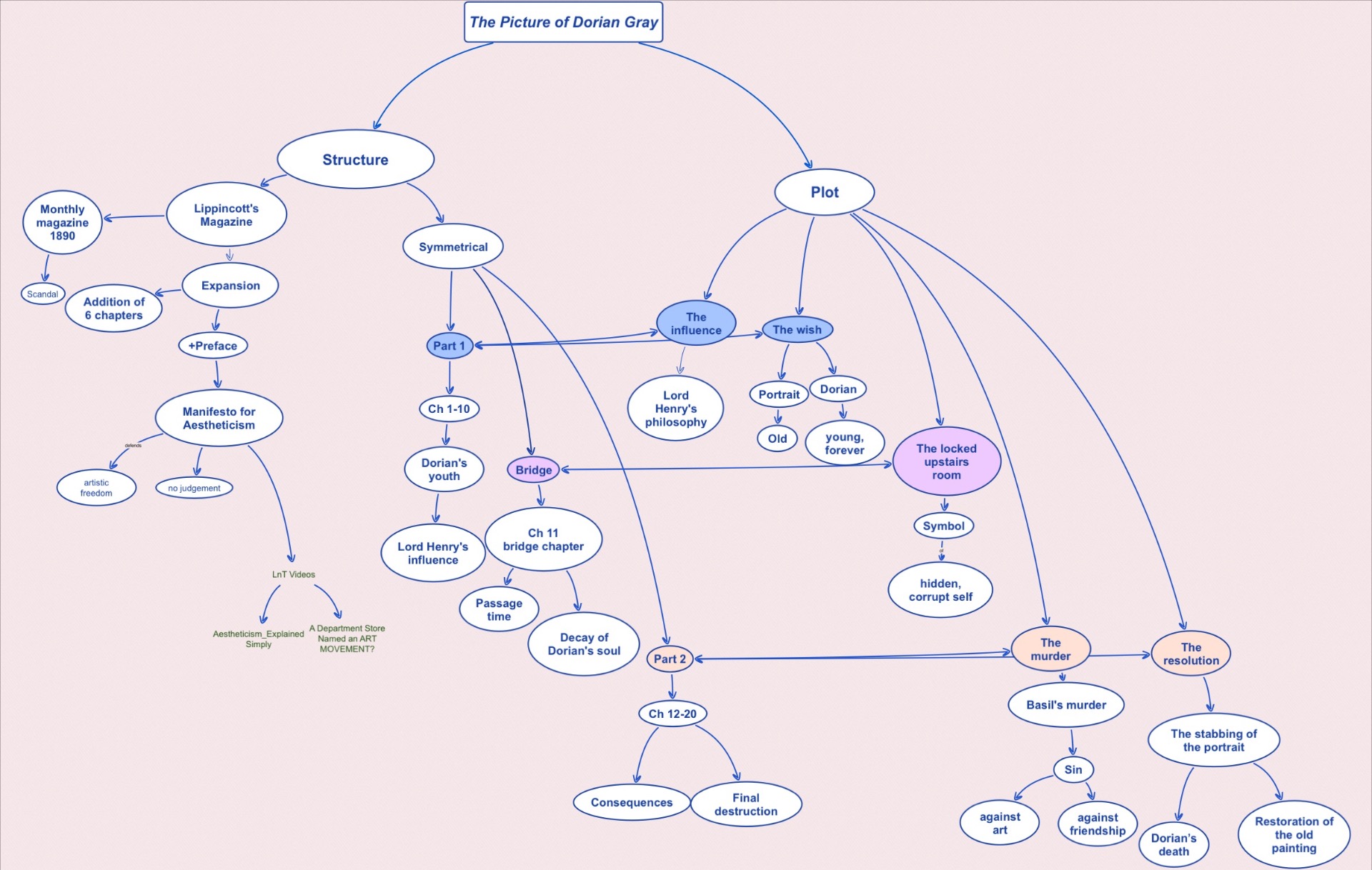
Mind Map 1 image goes here
Right-click your image in Webnode → Copy image address → paste into src=""For B1–B2 learners. Focuses on the core "Symmetry vs. Plot" relationship with fewer branches and clearer labels , ideal for first-time readers building their analytical framework.
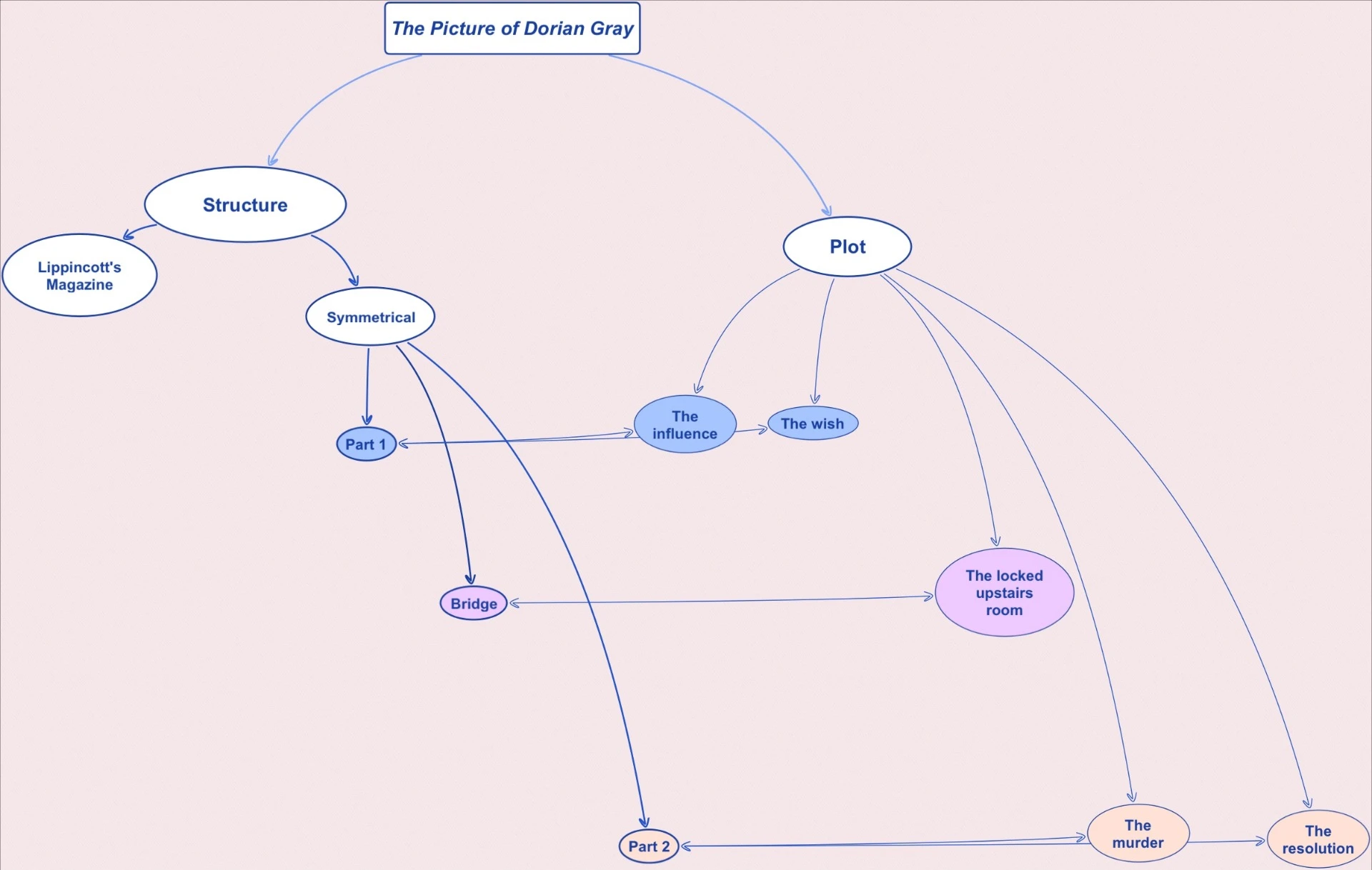
Mind Map 2 image goes here
Right-click your image in Webnode → Copy image address → paste into src=""Traces the technical evolution of the text , the 1890 magazine version, the 1891 expanded novel, and the addition of the Preface. Shows how censorship shaped the final published form.
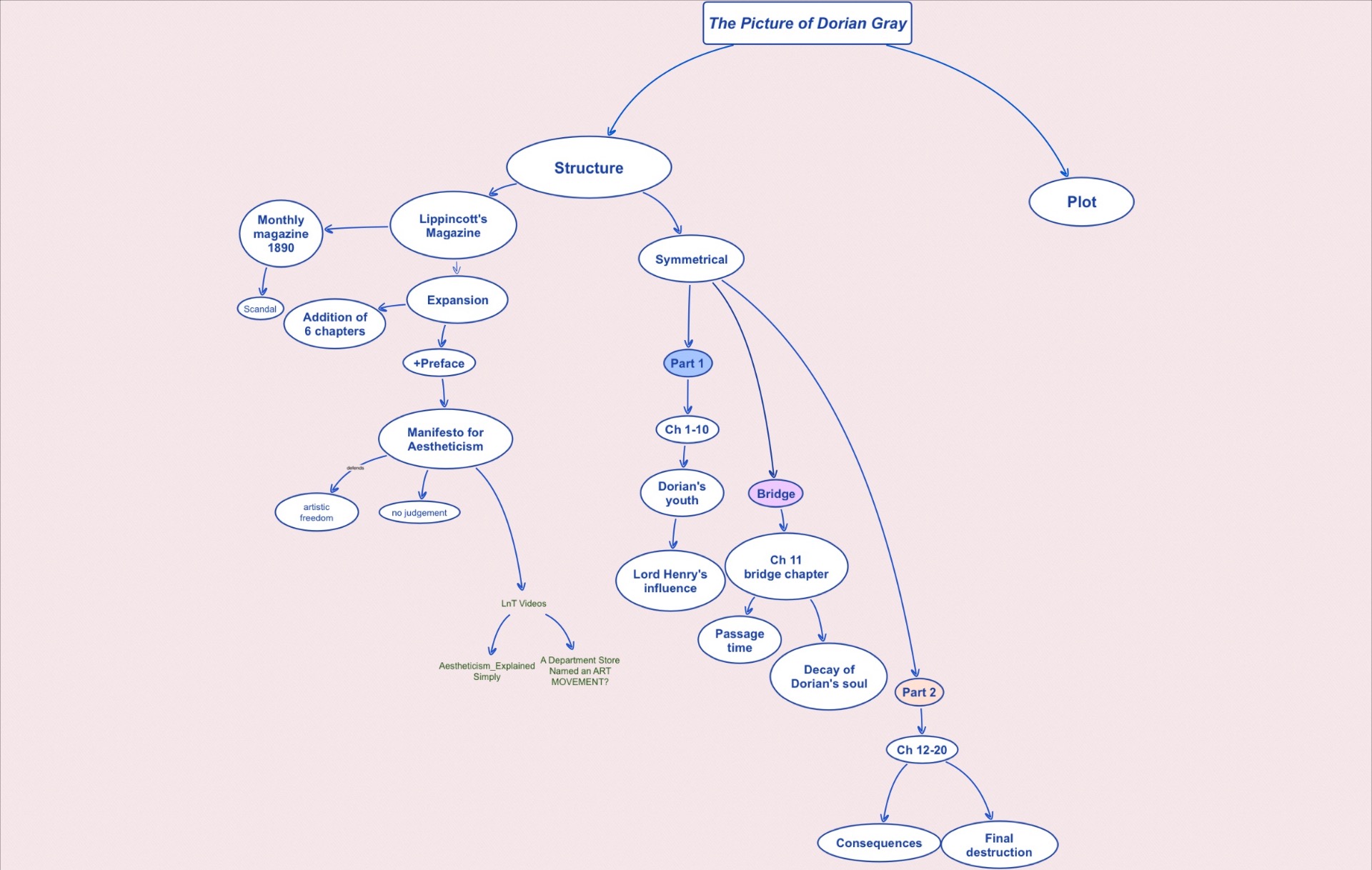
Mind Map 3 image goes here
Right-click your image in Webnode → Copy image address → paste into src=""Tracks specific plot milestones from Basil's studio to the locked room. Perfect for identifying the chain of cause and effect and understanding each turning point in Dorian's moral descent.
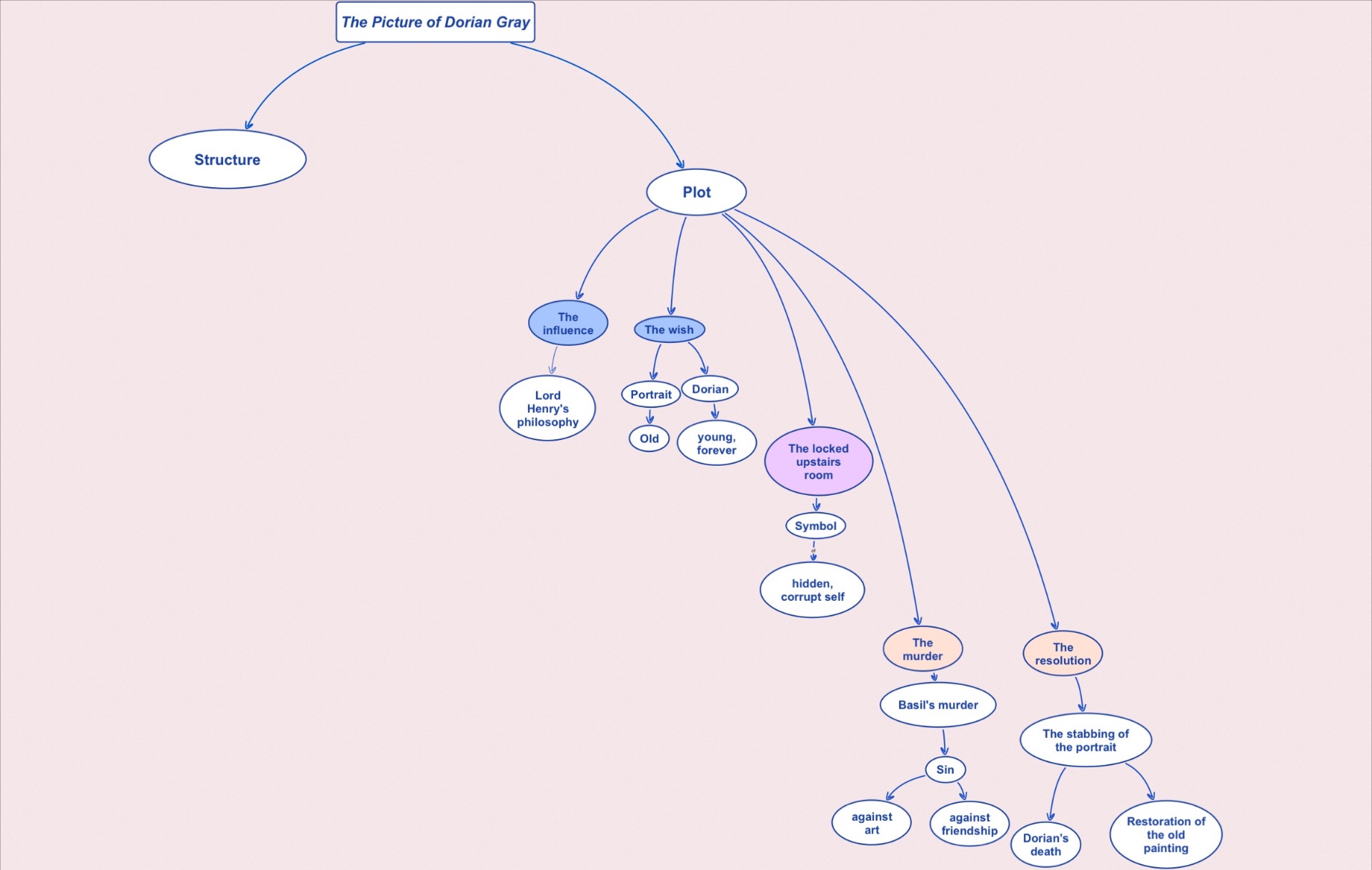
Mind Map 4 image goes here
Right-click your image in Webnode → Copy image address → paste into src=""Screenshot or print this blank template and fill it in from memory , the most effective form of exam preparation. Can you connect all the plot points and structural features without looking at the other maps?
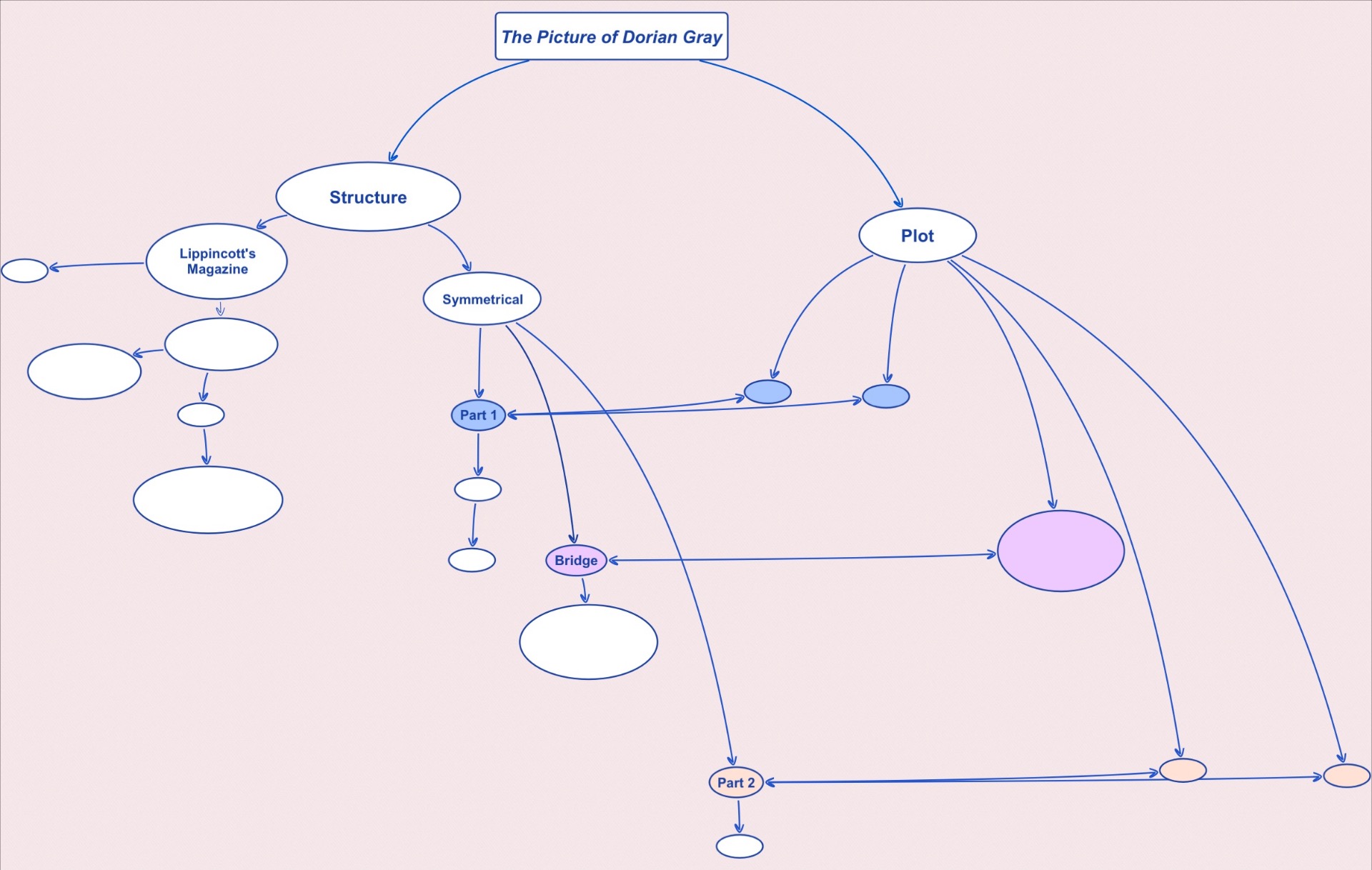
Blank Mind Map image goes here
Right-click your image in Webnode → Copy image address → paste into src=""Study Sheet — The Picture of Dorian Gray
Literature ... no Trouble · Ms. Anna-Maria Bellomo
| Word / Expression | Meaning | Translation | |
|---|---|---|---|
| Expansion | The action of becoming larger or more extensive | ||
| Censorship | The suppression of speech or public communication | ||
| Tone down | To make something less intense or extreme | ||
| Temporal shift | A change or jump in the passage of narrative time | ||
| Faustian bargain | A deal that trades morals or soul for success or power | ||
| Hedonistic | Engaged in the pursuit of pleasure above all else | ||
| Conceal | To keep from sight; to hide deliberately | ||
| Restoration | The action of returning something to its former condition |
- Divided intoThe novel is divided into two symmetrical sections; the book is divided into three main parts.
- Represents the idea ofThe locked room represents the idea of a hidden guilty conscience; a white flag represents the idea of surrender.
- A chain of cause and effectYou have to see the plot as a chain of cause and effect; climate change is a chain of cause and effect.
- Descends intoOver 18 years, Dorian descends into moral corruption; the conversation quickly descended into an argument.
- Unable to bearUnable to bear the portrait's hideous reality, Dorian stabs the canvas; she was unable to bear the heat so she went inside.
The passive voice is especially useful when presenting a literary work because it shifts the focus onto the text itself rather than the author's personal actions.
- The novel is divided into two symmetrical sections. (structural focus)
- The subtext was toned down due to censorship. (historical focus)
- The portrait is concealed behind a locked door. (narrative focus)
- Six new chapters were added in the 1891 edition. (textual focus)
Tap each card to reveal its definition and an example sentence in context. Tap again to flip it back.
The novel is divided into three symmetrical parts. Part 1 presents Dorian's youth; Part 2 is the bridge chapter marking the passage of time and the decay of Dorian's soul; Part 3 brings the final destruction. Click each event to expand the analysis.
- Bristow, Joseph, editor. Oscar Wilde and Modern Culture: The Making of a Legend. Ohio University Press, 2008.
- Ellmann, Richard. Oscar Wilde. Hamish Hamilton, 1987.
- Ford, Boris, editor. The New Pelican Guide to English Literature, Vol. 6: From Dickens to Hardy. Revised ed., Penguin Books, 1990.
- Gagnier, Regenia. Idylls of the Marketplace: Oscar Wilde and the Victorian Public. Stanford University Press, 1986.
- Kohl, Norbert. Oscar Wilde: The Works of a Conformist Rebel. Translated by David Henry Wilson, Cambridge University Press, 1989.
- Levine, George, editor. The Cambridge Companion to the Victorian Novel. Cambridge University Press, 2001.
- Marlowe, Christopher. Doctor Faustus. 1604. Edited by Roma Gill, A&C Black, 1989.
- Nation, I.S.P. Learning Vocabulary in Another Language. Cambridge University Press, 2001.
- Ovid. Metamorphoses. Translated by A.D. Melville, Oxford University Press, 1986.
- Pater, Walter. The Renaissance: Studies in Art and Poetry. Macmillan, 1873.
- Punter, David. The Gothic. Blackwell Guides to Literature, Blackwell, 2004.
- Punter, David. The Literature of Terror: A History of Gothic Fictions from 1765 to the Present Day. Longman, 1980.
- Raby, Peter, editor. The Cambridge Companion to Oscar Wilde. Cambridge University Press, 1997.
- Raby, Peter. Oscar Wilde. Penguin Critical Studies, Cambridge University Press, 1988.
- Stokes, John. In the Nineties. Harvester Wheatsheaf, 1989.
- Thornbury, Scott. How to Teach Vocabulary. Pearson Longman, 2002.
- Wilde, Oscar. The Picture of Dorian Gray. Lippincott's Monthly Magazine, 1890. Revised and expanded ed., Ward, Lock and Company, 1891.
- Worth, Katharine. Oscar Wilde. Penguin Passnotes, Macmillan, 1983.